
Three months ago, I sent an availability inquiry for a villa in Provence. Within 48 hours, I received 23 marketing emails from luxury concierge services, wine tour operators, and private chef companies I’d never contacted. My inbox became a battlefield.
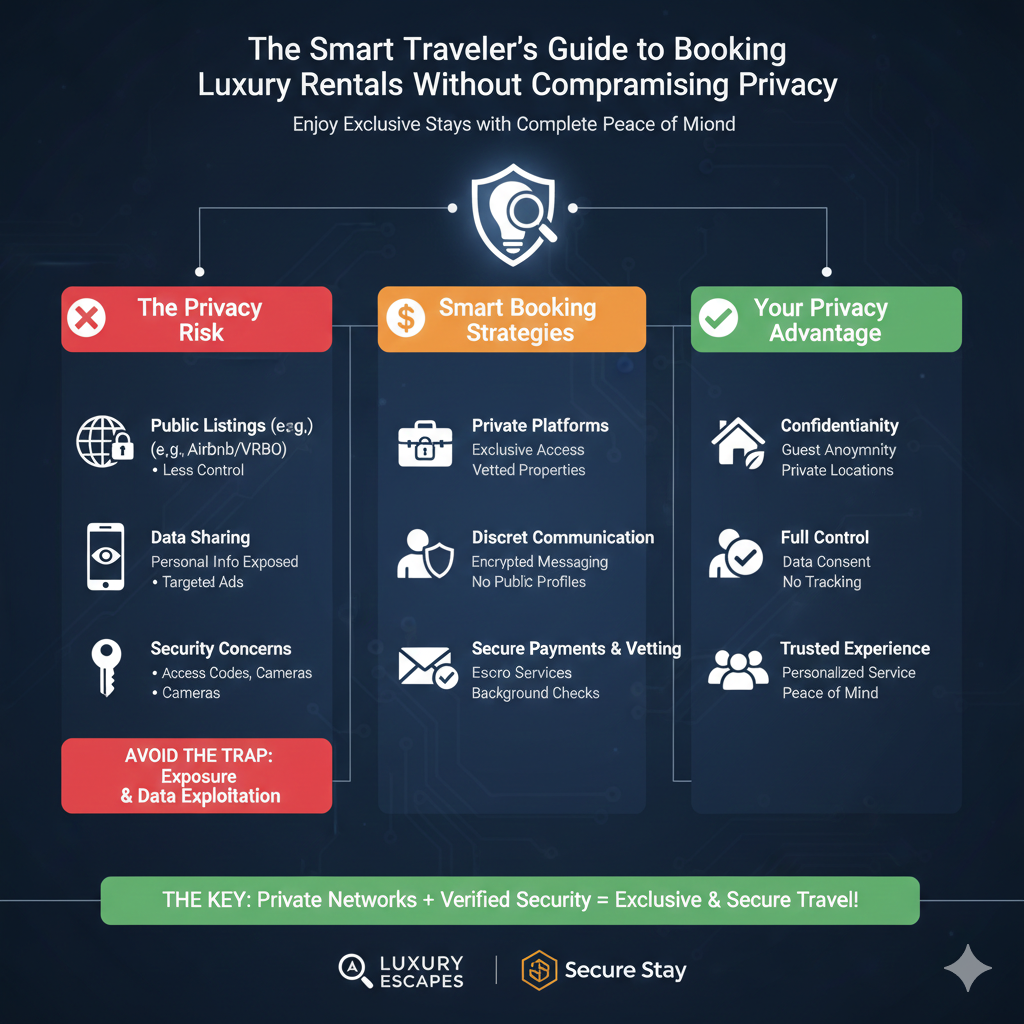
The villa owner had sold my contact information—or more likely, their property management software automatically shared it with “preferred partners.” Either way, my simple question about a weekend getaway triggered an avalanche of unwanted solicitation.
If you book luxury rentals regularly, you’ve experienced this. The beautiful property. The promising photos. The inquiry form asks for your email, phone number, and detailed travel plans. And then the flood begins.
There’s a better way.
Why Luxury Travel Attracts Aggressive Marketing
High-net-worth travelers are valuable targets. A family booking a €6,000/night villa probably also needs private transfers, in-villa dining, wine experiences, yacht charters, and spa services. Every luxury service provider wants access to that guest.
Property owners often monetize guest data through “concierge partnerships.” They frame it as adding value—giving you curated recommendations—but functionally, they’re selling access to your inbox. Some do this transparently. Many don’t.
The result? You inquire about a peaceful retreat in Tuscany and spend the next month unsubscribing from mailing lists you never joined.
This isn’t limited to independent properties. Even established rental platforms share your data with third parties. Read the privacy policy of any major vacation rental site—you’ve consented to your information being used for “marketing purposes by trusted partners.” That’s code for “we’re going to monetize your contact details.”
The Temporary Email Strategy
Here’s what savvy travelers do: they use a disposable email address for initial inquiries.
The concept is simple. Instead of giving out your primary email when browsing luxury rentals, you generate a temporary inbox that forwards messages to your real email for a limited time—say, 48 hours or a week. You get the information you need. If the property is legitimate and you’re ready to book, you transition to your real email for the actual reservation.
If the property turns out to be disappointing, overpriced, or if the owner starts spamming you? The temporary email expires, and they can’t reach you anymore. No need to unsubscribe from a dozen mailing lists. No need to mark them as spam. The inbox simply stops existing.
I started doing this after a particularly aggressive property manager in Santorini. I’d inquired about a cliffside villa. Didn’t book—found a better option elsewhere. For three months afterward, she sent weekly “exclusive offers” and “last-minute availability” emails.
Every single one went to a temporary address that had already expired. She was sending messages into the void.
When Privacy Protects More Than Your Inbox
For some travelers, privacy isn’t about avoiding marketing emails—it’s about personal security.
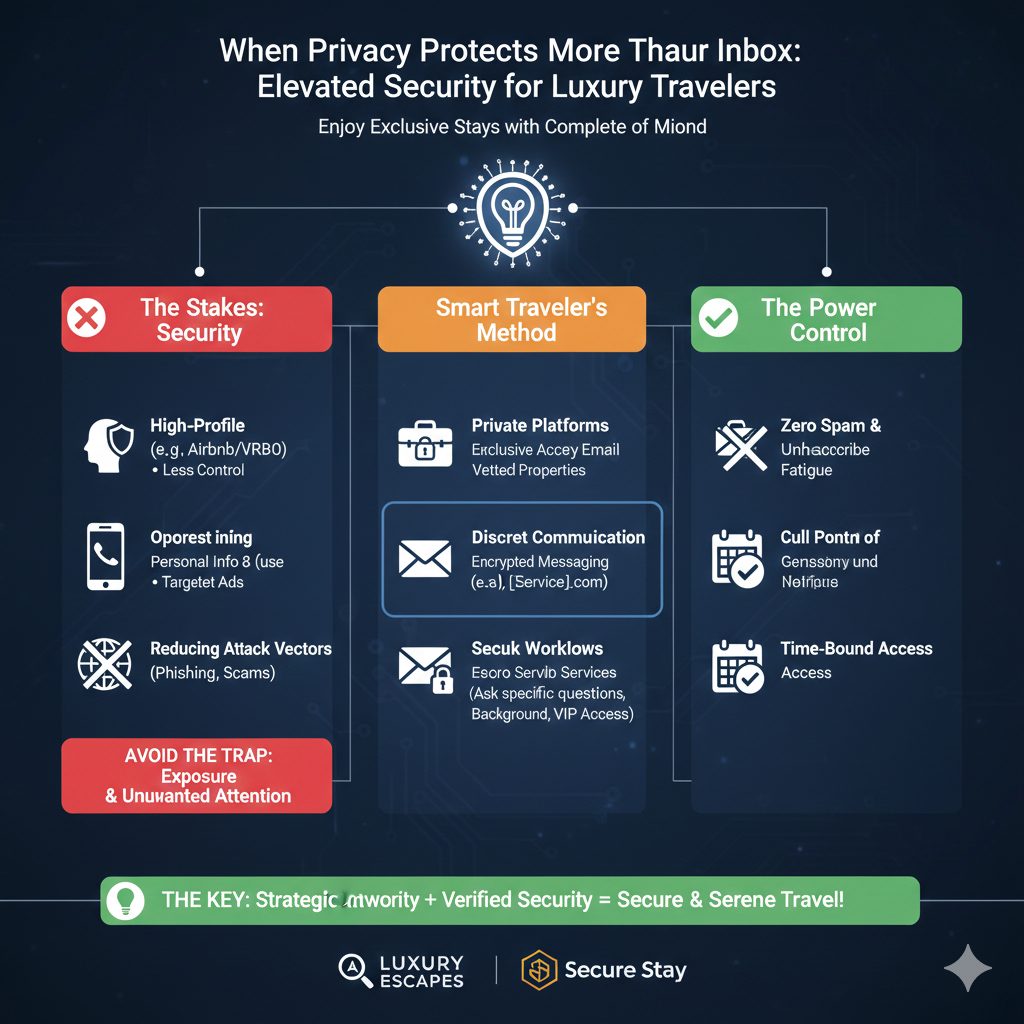
High-profile executives, celebrities, and individuals with security concerns can’t casually throw their contact information around. An inquiry about a luxury rental in Ibiza shouldn’t end up in a marketing database accessible to dozens of vendors and contractors.
I know a family office coordinator who books retreats for a tech billionaire’s extended family. She never uses the family’s actual contact information for initial property research. She scouts 20-30 properties per event, requesting detailed information, floor plans, and availability.
Only the final 2-3 properties that make her shortlist ever receive legitimate contact details.
This isn’t paranoia—it’s operational security. The more people who have your contact information, the more vectors exist for social engineering, targeted phishing, or simply unwanted attention.
Even for everyday travelers without security teams, there’s value in controlling who has access to your primary communication channels. Your inbox is valuable. Treat it accordingly.
How to Actually Do This
The mechanics are straightforward. When you’re browsing luxury rental properties and an inquiry form asks for your email, don’t use your primary address.
Instead, generate a temporary email through one of many services designed exactly for this purpose. You’ll get a working email address instantly—something like relaxed-tiger-8472@[service].com. Use that for your inquiry.
The property owner sends their response, which forwards to your real inbox. You read it, evaluate the property, maybe ask follow-up questions. If you decide to book, you transition to your permanent email for payment and formal reservation details.
If you don’t book, the temporary address expires after your set timeframe, and you never hear from them again. No unsubscribe fatigue. No email filters. No wondering why you’re still getting promotional emails from a property you inquired about six months ago.
This works for more than just initial inquiries. Use it for:
- Requesting property brochures and photo galleries
- Asking about seasonal pricing and availability
- Signing up for “VIP early access” to new properties
- Downloading rental guides and area recommendations
- Contacting multiple properties when you’re comparison shopping
Basically, any interaction before you’ve committed to booking should use throwaway contact information.
The Legitimate Privacy Concerns of Property Owners
Now, from the property owner’s perspective, I understand the frustration. You’re running a luxury rental. You invest time crafting personalized responses to inquiries. You check your calendar, calculate custom packages, recommend local experiences.
And then the prospect vanishes. Never responds. Was never serious to begin with.
Some of those inquiries? Temporary emails from browsers who were never going to book.
But here’s the thing: that’s the cost of operating in a competitive market. Travelers browse multiple properties before deciding. We compare. We request information. We change our minds. That’s normal consumer behavior, and expecting otherwise is unrealistic.
The solution for property owners isn’t demanding permanent contact information upfront—it’s filtering inquiry quality on the backend and creating such a compelling offering that prospects want to book.
When I find a truly exceptional property with responsive service, fair pricing, and genuine attention to detail, I happily provide my real contact information because I want to book it. The properties that struggle with conversion are usually the ones that fail on one of those fronts.
Evaluating Properties Beyond the Photos
Speaking of browsing multiple properties: here’s something most luxury travelers don’t think about when comparing options.
Let’s say you’re looking at villas in Alicante. You’ve narrowed it down to three finalists: “Casa Blanca Alicante,” “White Villa Alicante,” and “The White House Spain.”
They all have similar aesthetics. Comparable amenities. Nearly identical pricing. How do you differentiate?
One thing I’ve learned: check how unique the property name actually is. Properties with generic, easily confused names often indicate operators who aren’t thinking strategically about their business. They picked a name that sounded nice without considering that 50 other properties in the region use variations of the same words.
This matters because it signals attention to detail—or lack thereof. If a property owner couldn’t be bothered to check whether their name stands out in a crowded market, what else are they overlooking? The booking process? Maintenance? Guest communication?
Conversely, properties with distinctive names often reflect operators who think holistically about their business. They’ve considered branding, market positioning, and competitive differentiation. In my experience, those are also the properties that deliver better guest experiences.
It’s a small data point, but it correlates surprisingly well with operational quality.
The Art of Comparison Shopping
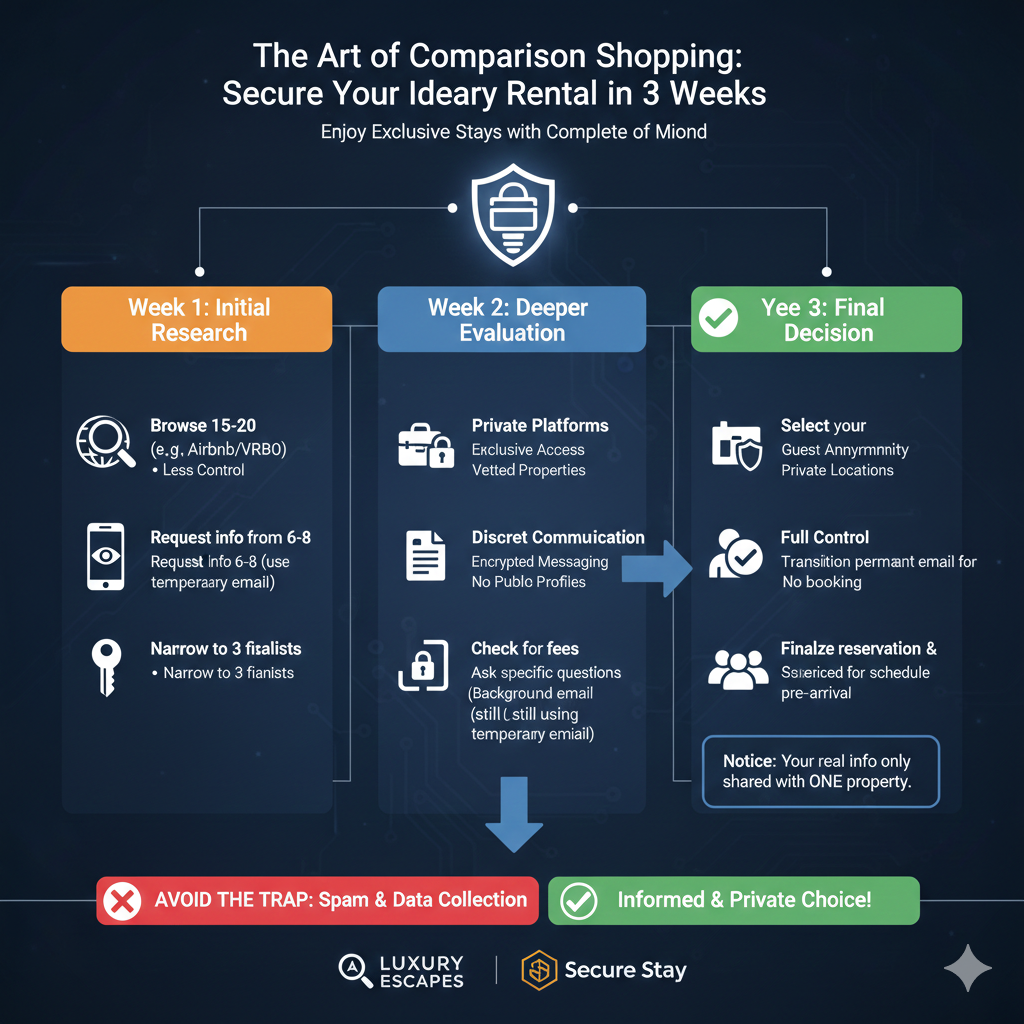
The ideal luxury rental booking process looks like this:
Week 1: Initial Research
- Browse 15-20 properties in your target destination
- Request information from 6-8 top contenders using temporary email
- Evaluate responsiveness, pricing, and availability
- Narrow to 3 finalists
Week 2: Deeper Evaluation
- Request detailed floor plans and amenity lists
- Ask specific questions about your travel dates and needs
- Check for any additional fees or restrictions
- Still using temporary email for all communication
Week 3: Final Decision
- Select your property
- Transition to your permanent email for booking
- Provide payment information and finalize reservation
- Schedule pre-arrival communication with property manager
Notice: you’re only exposing your real contact information to one property—the one you’re actually booking. The seven properties you browsed but didn’t choose? They only ever had access to your temporary email, which has already expired.
This protects your privacy while still giving you the information needed to make an informed decision. You haven’t been rude to property owners. You haven’t wasted anyone’s time. You’ve simply controlled the flow of your personal information.
When to Reveal Your Real Information
There are obvious situations where you need to use your permanent email:
- Signing the actual rental contract
- Providing payment information
- Coordinating arrival logistics and key exchange
- Communicating during your stay
- Post-stay follow-up and reviews
None of this requires your real email during the initial inquiry phase. Save your permanent contact details for when you’ve moved beyond browsing into actual commitment.
Some property owners require verification before sharing detailed information. That’s legitimate—they’re protecting their proprietary floor plans and pricing strategies. In those cases, a video call or phone conversation is more appropriate than demanding your permanent email upfront.
What This Means for Your Next Luxury Rental
The next time you’re shopping for a luxury villa, yacht charter, or private estate rental, think strategically about your contact information.
Your email address is a direct line to you. It has value. Treat it like any other asset—don’t hand it out freely to every property that asks for it.
Use temporary emails for browsing and initial inquiries. Protect your primary inbox from the inevitable marketing flood. Control who has access to your contact information.
When you find a property worth booking, transition to your permanent email and build a real relationship with the property manager. Great luxury rentals are built on trust and communication—but that trust should be earned through quality and service, not extracted through aggressive data collection.
Luxury travel is supposed to be relaxing. Your inbox shouldn’t become a source of stress because you asked a simple question about availability.
What properties respect your privacy during the inquiry process? Those are often the ones worth booking. The ones that immediately add you to eight mailing lists? They’ve already told you everything you need to know about how they’ll treat you as a guest.
Choose accordingly.
The Bigger Picture
This isn’t really about luxury rentals—it’s about asymmetric information in digital transactions.
Every time you provide contact information online, you’re entering an unequal exchange. The recipient can do essentially whatever they want with your data. Send unlimited marketing. Share it with partners. Sell it to data brokers. Add you to lists you never consented to.
Your only recourse is to unsubscribe one message at a time, aggressively filtering your inbox, or just accepting the noise.
Temporary emails level the playing field. They give you control over a transaction that usually favors the business. You can browse, inquire, and evaluate without permanently exposing yourself to marketing machinery you never agreed to activate.
This applies far beyond luxury travel. Any time you’re shopping for high-value services—private schools, medical procedures, investment opportunities, executive coaching—the same dynamic exists. Businesses want your contact information. You want their information. Temporary emails let you get what you need without sacrificing your privacy.
It’s not about being secretive or dishonest. It’s about maintaining boundaries in a digital economy that constantly pressures you to surrender them.
Your next luxury rental should be a retreat from the noise, not an invitation for more of it. Start planning accordingly.
Conclusion
Somewhere along the way, we accepted that browsing online meant surrendering pieces of ourselves—our email, our phone number, our plans, our habits—just to ask a basic question. We normalized the idea that a single inquiry should open the door to weeks of unsolicited pitches and marketing noise. That’s backwards.
Luxury travel is supposed to feel intentional and calm. Thoughtful choices. Curated experiences. Fewer things, but better ones. Your digital behavior should match that same philosophy.
You wouldn’t hand your house keys to every concierge on the street just because you’re comparing restaurants. So why hand out your primary inbox—the place where your work, finances, and personal life all converge—to every property you casually browse?
A temporary email is a small, almost boring tool. It’s not flashy or complicated. But it quietly flips the power dynamic. It lets you ask questions, gather details, compare options, and walk away cleanly if something isn’t right. No guilt. No unsubscribe marathons. No lingering digital clutter months after the trip is over.
And here’s the irony: the best properties—the ones truly worth booking—won’t be bothered by this at all. They’ll win you over with service, clarity, and professionalism. When you’re ready to commit, you’ll happily share your real details because trust has been earned, not extracted.
That’s how it should work.
So the next time you start planning a getaway, think of your contact information the same way you think of your time or your money: spend it deliberately. Protect it until something deserves it.
Because a luxury escape should begin with peace of mind—not an inbox full of noise you never asked for.